Showing posts with label change. Show all posts

Monday, January 12, 2015

Chemicals: Villains of the Natural World...or Not


Recently, something fascinating was brought to my attention by a speaker on biomimicry. Interested in what that means? Read on to learn more...

There is a common misconception. This misconception is that chemicals are man-made hazards that pollute and threaten an otherwise chemical-free natural world.

Chemical [kem-i-kuh l] (noun)
1. a substance produced by or used in a chemical process.
2. of or relating to, used in, or produced by chemistry

Chemistry? Remember chemistry class? The science class that tried to teach you about the structure and property of substances and the changes they go through. And the Periodic Table of the Elements! Everyone knows that. But most of those elements didn't seem so evil...Carbon, Oxygen...the building blocks of life are contained in that colorful table.

So maybe chemicals aren't pure evil. Certainly combinations of them can be harmful to the health of living things - but chemicals are the building blocks of everything - natural and not.

There is this perception that the word "chemical" is evil, yet nature offers some incredible natural chemical solutions to very real world problems. Seashells inspiring self-assembling in nanotechnology. Plants inspiring biodegradable plastics made from CO2. Peacocks and butterflies inspiring color with light instead of pigments.

If we are going to truly understand chemistry enough to make real change - we need to stop villainizing chemicals and look to understand them instead. Biologists are being invited to the design table. Taking inspiration from nature to design for a sustainable future.

"Learning about the natural world is one thing. Learning from the natural world, that's the switch. That's the profound switch." -Janine Beynus, Biomimicry
Learn more at biomimicry.net
http://biomimicry.net/inspiring/

Thursday, January 8, 2015

The Super Coolest Thing Ever

Remember to step back and appreciate the grandeur of what you do.

Recently attending a conference by Textile Exchange in Portland, Oregon, I listened to an amazing Nike bigwig - Adam - talk about the merits of sustainability at Nike. But Adam also brought up a point that was too good to not share.

He told a story where he was on the plane. The guy next to him was reading an article in a magazine about Nike releasing garments made from recycled water bottles. Thrusting the magazine into Adam's face, his eager neighbor exclaimed, "Have you heard about this bro? Water bottles into clothing?? That is the super coolest thing ever!"

At this point, Nike had been working on textiles from recycled water bottles for several years. Adam had been integral in this process, dealing with the growing pains of whether 50% waste or 20% waste was enough of a hurdle - or if zero waste was the only acceptable option. Hours and years of struggles with this a topic inspired less than a "just do it" feeling in the pit of Adam's stomach.

A little put off by his seat-buddy's overzealous introduction and feeling unamused with the subject, Adam leaned forward to respond when words suddenly hit him a little deeper -

That is the super coolest thing ever.

He thought: We make clothing out of water bottles. Something that didn't exist not too long ago. We found a way to recycle something hard on the environment and creating waste in our world. We are making a difference.

"You know what?" Adam conceded happily, "you're right. That is the super coolest thing ever."

This simple anecdote reminded me of how often when we work so hard towards a goal, churning on the problems and obstacles standing in our way for too long, we lose sight of how amazing and important the work we are doing really is. When you are feeling frustrated by minimal progress, staunch opposition, or just being stuck - let's step back and give our journey a chance to speak for itself.

The work we do is important - it will take years, many people, and lots of energy to take the little steps that eventually carry us over the finish line. The work we do is not easy - but the struggle makes us stronger and teaches us lessons for a better future. And, who knows? The work we do, when shown to an outsider - say, an excited dude on a place - might just be the super coolest thing ever.

Find out more about Nike uniforms made from discarded water bottles: http://www.ecouterre.com/nike-outfits-world-cup-teams-in-jerseys-made-from-recycled-bottles/
http://www.ecouterre.com/watch-how-nike-recycles-plastic-water-bottles-into-football-jerseys-video/

Monday, January 5, 2015

By Design, Not by Default

For a long time, there has been a major assumption about Sustainability in business. Not always explicitly stated, but clearly communicated through actions taken by the majority of businesses: Sustainability should happen by default.

Whether through the power of intrinsically-motivated leadership or due to the nature of the industry, some companies just "get it". Outsiders assume these leading companies default to sustainable actions - seemingly at odds with stakeholder interests or other business goals. 

Other companies wait until their hands are forced, by bad press from negative consequences of unsustainable practices or other means. These companies ignore sustainable options until they are in the middle of controversy and must respond quickly, without preparation, and often under the scrutiny of the public eye. 

But as a whole, people are beginning to recognize that true sustainable business practice must happen by design and not be default. Those first companies succeed not because they stick to sustainability despite good business sense - it is because they have incorporated sustainability into the core of their business strategy. Sustainability is a lens through which we can view our business practices and make decisions not to the detriment of stakeholder value, but to enhance everything we do as value creators. 

The other kind of company may not have holistically implemented sustainability into its business strategy - but still is beginning to recognize the value of considering sustainability as a highly effective method of risk management, as a tool for capturing more customer value through marketing, as a longer term and truer financial valuation of the company not just in the snapshot of today but as it will exist ten years in the future. 

So, wherever you are of the spectrum of completely integrating Sustainability into your business strategy or just looking to explore how sustainability can enhance your business strategy, grab your drafting pencils and blueprint paper. As in building anything else, constructing Sustainability into your business strategy starts from the foundation. It is a material with which we use to build structure and strength into our businesses - not a coat of green paint we apply liberally to the outside whenever green is en vogue. Sustainability ensures we will succeed, sustain, and thrive well into the future. 

Wednesday, November 2, 2011

Occupying Sustainability

I love the Occupy movement that is going on right now.  I am proud that people are actually expressing their discontent for the greed and the institutions in the USA and globally that feed into that greed. I didn't think Americans had it in them to rock the boat.  I say this because in the USA we have so much in comparison to developing countries where poverty and the lack human rights are prevalent.  So I figured we would never make too much noise for fear of losing what we do have.  But what I see here in the USA are people who feel frustrated that all of our efforts cannot be boiled down to making profit for companies.

Watching the news and with what is going on with Occupy Wall Street and the additional Occupy movements made me think of the corporations that fit into this protesting.  Specifically those companies where social and environmental responsibility are not a part of the company ethos, where truly they are focused on profit for profits sake.

Often when sustainability experts talk about the reasons why companies should invest in authentic sustainability behaviors and initiatives it is driven by a sense of risk if you don't.  I see the Occupy movement as a risk.  If you are a company that cannot show their commitment to sustainability then they are a target - as another institution that does not serve the people of the USA nor the planet.

Customers have choice now - if I want to buy a laundry detergent I can buy it from a company that invests not only in providing a clean non-toxic product, but one that has a robust benefits program for its employees and that invests back into its community. I don't have to buy it from a multi-national corporation that does not deliver on these issues.

Watching the campaign to move your money from your bank and putting it with a local credit union is propping up the notion that "we the people" have power and the ability to exercise that right through the purchases and investments we make.

There is an energy in the air that is new, that is dynamic and powerful.  What will come out of this is anyone's guess, but if I were a company that did not have a commitment to its employees, customers, the environment and the global community I would be starting to think it might be time. 

Friday, April 8, 2011

Guest blog - The H-Word

I think the word “habits” has a bad reputation. It seems to carry with it a sort of negative connotation. Makes you think of “smoking” and “addiction.” Or maybe that’s just me, because I have some experience with bad habits. When I read Nicole’s latest blog, “You May Ask Yourself…” at the bottom she questions the formation of habits, how they come to be and why we get stuck in them and how we stay clear of those unhealthy ones. It inspired me to pursue the conversation because I have a few thoughts to share on that subject.

There’s a saying that a ladder of success has three rungs: unconscious incompetence, conscious competence and unconscious competence. We can move through being unaware of our inability to being unaware of our ability – or, in this context a bad habit versus a good one where, eventually, it won’t even be a habit anymore but just a positive piece of your life.

I spent most of my 20s in unconscious incompetence. Since this is a "family" rated blog I won’t go into the gritty details but suffice to say I enjoyed living a life of excess, of a lack of responsibility, the sort of perennial teenage dream. Credit card? Nope – bad credit. Nest egg, or savings account? Nope – spent it going out with friends to the local watering holes after work. I basically thought the term “mutual fund” was actually “mutual fun” and had no concept of thinking about my goals beyond getting to the party on the weekend (despite the fact every day was the weekend in that state of mind).

I don’t really know how I got out of it, but I did. It was tricky. I had to say goodbye to some close friends who, ironically, I’ve never seen again. I moved. I started to focus on my career. I stopped drinking – that was the big one because everything else was attached to it… every night of overindulgence always started with just a few beers.

Making the decision to stop was the hardest part. But once I’d said to myself, “This isn’t working anymore” and moved into conscious competence, I started to look at my options. I figured out what I needed to do to break the bad habits and the easiest part, by far, was just sticking to the plan.

A year and a half later I’ve learned a lot about habits. Old, bad habits can be broken if you just stick with it. And you know what else? There are a ton of great, positive habits out there that can be learned. Habits are a way of acting that can be adapted – sure it’s difficult at first but if you keep repeating the action one day you won’t even notice what you’re doing. I’ve since made a habit of walking to work and back every day. I’ve made a habit of recycling, buying organic/local foods and paying attention to green cleaning products. I’ve made a habit of taking my vitamins and drinking water throughout the day. They were all small changes on their own, but with each I’ve watched them change from conscious effort to second nature. Just like the metamorphosis into unconscious competence that was breaking my worst bad habit - the destructive course of my life - and finally growing the hell up!

So I guess at the end of the day, I would answer Nicole by saying: no, we don’t need to just wait for our bad habits to consume us, and yes we can avoid them. We just need to get to that first level of consciousness, and be aware of what we want to change - like she has done with her decision to stop driving to yoga class. :) Once we take that first big step toward our goal, the rest will fall into place. 

Emily Kendy lives in Vancouver, BC. She is the Project Coordinator of Renewable Energy Projects for Eaga Canada. She likes to write fiction (and sometimes non-fiction) in her spare time.

Thursday, March 31, 2011

Surviving the Meta Trends

I gave a presentation at the Los Angeles International Textiles Show earlier this week and the topic was Sustainable Meta Trends in Textiles.  In all honesty I didn't know what a Meta Trend was until a few weeks prior. I looked it up and basically META is something transformational.
So it is not just what is new, but what is going to change significantly.
Pretty daunting - and to boot, my presentation was pretty daunting as well, as the impact of the textile industry on the planet is significant.

Often however we hear these significant meta statements about poverty, climate change, obesity, water, land and energy shortages and we cannot comprehend how to digest that information into our daily lives. At least I find it quite difficult. So I started thinking about a way to make these huge pieces of information enter my brain with some kind of comprehension. And the way I look at it is to find some kind of transformational experience that I have already gone though and build a connection.

For instance - when I worked as a freelancer and now as a consultant and do not have the same income I was used to - you begin to adapt and start living differently, you prioritize, and alter your behaviors.  I have seen the same with friends and family who have children, your life is now different, you adapt.
Another example - our pipes broke and had to turn off the water in our home for a day, we re-looked at how we lived, what could we do without water and still live.

These maybe small items, but it shows how if we step back and look at the times in our lives that we have been able to change, and change our behaviors we usually can do it. So you can look at these Meta trends as warnings for the areas of the world that are going to change and you can start practicing now. 

Friday, March 11, 2011

Guest blog - Sustainability from your not so Average Joe

There are three (at least) reasons why I should not write about sustainability for this blog: 1) I really don’t know a lot about the topic. 2) I don’t exactly live an exemplary life when it comes to sustainable practices. 3) Even if I did have any insights, they likely wouldn’t apply to the population at large, because I live in a very remote and unique environment – the Canadian Arctic.
Nicole, however, won’t take no for an answer, and so here we are. I think, in her wisdom (?) she might think that I might have something relevant to say for the very reasons I think I don’t. So I’m going to tackle this piece from that perspective, then, and see what happens.


1. What do I know about living sustainability? Putting it simply, I would say it is about doing what you can. Not talking or thinking or wishing or regretting. But DOING. It is easy think of endless excuses why we cannot do X.  So perhaps the key is to start by focusing on doing Y…the things we can do. For example, where I live there is no recycling program and no organic options at our grocery store. I can’t do anything about it.  However, I can (and did) make the decision to be a single-vehicle family.  With two young children to cart around and a climate that involves 6 months of winter and temperatures that regularly drop below -30 and -40 degrees Celsius, it would obviously be more convenient for my husband and I to each have a vehicle, but we make it work with one. There is something we did.

2. Like I said above – I don’t recycle. And OK, so we only have one vehicle, but that one vehicle idles a lot (to keep warm in the aforementioned formidable climate). And sometimes I let the water run when brushing my teeth. We use disposable diapers (gasp!) I could go on. So why would Nicole want a baddie like me telling y’all about my thoughts on sustainability? I guess maybe because I’m an Average Joe. Nicole has a Masters in Environmental Studies and sustainability is her passion. That’s not me. I’m a librarian and right now just getting through life with a toddler and an infant is my passion. So sometimes it feels like maybe the same rules wouldn’t apply to an Average Joe that would apply to a keener like Nicole. But if you take a few minutes to actually think about sustainable living (as I’ve been forced to do by going through this exercise) and go back to my simple definition, then even the Average Joe can do something. Or even better, a bunch of somethings. And the somethings can be easy (how hard is it to shut the water off when brushing your teeth?) And the somethings can have spin-off benefits (e.g. having one vehicle also means spending less money). And probably, the more somethings you do, even more positive choices will follow as you begin to be more conscious about sustainability.  And we don’t need a Masters in Environmental Studies for that. (And FYI, if you ever want to make something a habit, enlist the help of a toddler…those little guys are militant about habits. Are you lazy about turning off lights before you leave a room? Just get my son to help you flip off the light switch one time, and I guarantee you’ll have a little light-turning-off enforcer for life.)

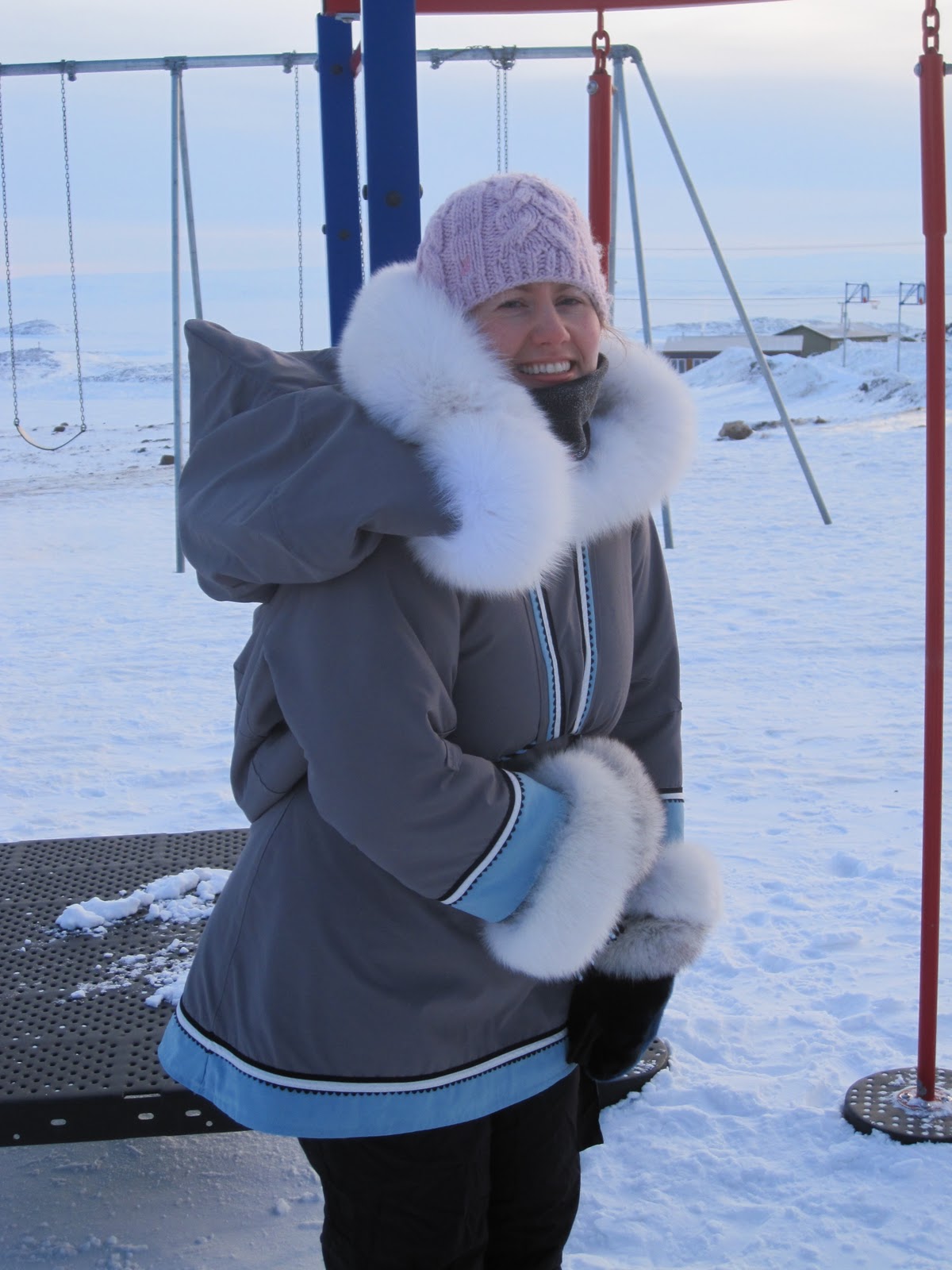
3. I’ve already mentioned just a couple of points about Arctic living that are not likely to be issues for the general readership. Even though I face some challenges up here, I’ve got some pretty amazing models from the Inuit culture, who managed to perfect sustainable living in the most cruel of environments. There are many, many more unique elements to my lifestyle (truly, I wish more people could visit up here and experience the wonders of the north). For example, when I take my kids for a “walk” at this time of year, one of them rides on my back in my amautiq and the other is pulled in a sled.  I think Nicole sees these anecdotes as a bit of a hook, because my experiences up here are so unique and tend to garner interest. But even if your life isn’t as glamorous or interesting as that of a northerner, I guess you can still go back to my simple definition of sustainable living and do what works wherever you happen to be, regardless of the challenges you face there.

Rae-Lynne Patterson Aramburo lives in Iqaluit, Nunavut in Northern Canada with her husband and two boys.  She graciously responded to my request to write a blog about living in the north and thinking about sustainability.  And I was right she has some great insights to share.  Thank you Rae.

Friday, February 18, 2011

Once you know, why do we convince ourselves otherwise?

I have gone back and been reading my old sustainability books.  The Ecology of Commerce by Paul Hawken, Confessions of a Radical Industrialist by Ray Anderson, and others.  And I read their observations on our impacts of business and human existence on the planet and am shocked by what we are doing.
But I have read these books before, I knew these impacts years ago, why does it keep shocking me?  I think in part because of the life I live I am quite removed from the visual impact of 2,562 tons of solid waste in a year from one company.  There are thousands of companies across the world, of course of various sizes, but we don't see all of the numbers added up together in daily life.

So while I know that driving my car, using water, gas, and creating waste are things I do on a small scale every day - what if I were to see this as a sum?  All totalled up would I see my impact differently and make the needed changes?
I think this would help dramatically - as I don't think it is a big deal to use my little Toyota Matrix every day for trips under 20 miles.  Heck it isn't like I am commuting 60 miles in an SUV?  But that there is the piece we have to be wary of, we can justify ourselves of anything.  And guess what - my lifestyle, my consumption, the waste I generate all have a place in that adding up of the world's impact.

What activists are trying to get at, is for ALL of us to think about the details of our impacts and make improvements.  It isn't about doing less so others can do more... it is about taking that responsibility and saying my life is adding to a really big number of global impacts and what can I do to lessen that.

Thursday, June 24, 2010

The pain of change


Interestingly businesses now and days do a great job of hiding the efforts behind the scenes of creating new products, new solutions, new ideas. By the time the customer interacts with it, the customer experience is made to be perfect. I think this has greatly skewed our expectations in our world today.
I buy a fancy new phone and now I can search the web, map where I am, find a cafe near by, take pictures, edit videos, etc. And when there is a dropped call I am gravely disappointed. Or if I purchase a shirt and after 10 washes it gets a hole - how could this happen? We have done such a good job of customer service and innovation and marketing that in all reality we live in a false world. Our expectations that anything can be done are incredibly high.
One side of me completely agrees (I am an optimist), the other side...
What impact will this level of expectations have on moving our world toward sustainability?
For instance, I am involved in a project currently where we want to change a regular behavior in our business to reduce our environmental impact. The first expectation was... "well can't we just change it and be done with it?" 6 months later we find that around ever corner is another set of questions and impacts that we had not thought of from the beginning. It will easily take us easily another 6 months to get this project off the ground. And when it eventually does happen, it will be talked about by our marketing and sales departments like it was an easy switch and we "just did it".
What gets lost here is the countless hours, conversations and testing to see if we can in fact make a sustainable change. I think if we lowered expectations so that they were more in line with the truth, we would see something remarkable happen. People wouldn't think of things in abstract, they would understand the steps it take. I invite all of you who were interested in making a change, but feared the time and effort - know that there is no other way. And what you will gain by going through the process is far greater than anything you can buy off the shelf.